
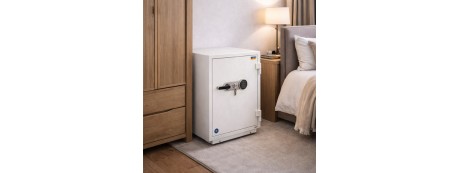
Burglary-Proof Safes, Fireproof Safes, Security Grades, and Expert Guidance from Gulfsafes — Saudi Arabia's #1 Safe Supplier Since 2008
Protecting your most valuable assets — whether they are irreplaceable family documents, high-denomination cash reserves, precious jewellery, digital storage media, or sensitive business records — is no longer a decision that can be deferred or treated lightly. Burglaries, office break-ins, accidental fires, and natural disasters strike without warning. When they do, the single factor that determines whether your most important possessions survive intact is whether you invested in the right safe, properly certified, and correctly installed by professionals who understand the real engineering standards behind modern vault security.
For both Saudi households seeking to protect their family's irreplaceable heirlooms and businesses across Riyadh, Jeddah, Dammam, Mecca, and Medina managing daily cash deposits, confidential records, and high-value inventories, the choice of safe is one of the most consequential physical security decisions you will ever make. It is a decision that directly affects not only your asset protection, but also your insurance position, your regulatory compliance posture, and — in the event of a loss event — whether your claim is honoured or disputed.
Since 2008, Gulfsafes has been the undisputed top supplier of both burglary-proof safes and fireproof safes across the Kingdom of Saudi Arabia. With over 17 years of proven expertise, thousands of successful installations spanning residential properties, commercial offices, retail outlets, banking institutions, hospitality properties, and government facilities, and a team of certified security consultants with deep knowledge of the Saudi market, Gulfsafes delivers not just safes — but genuine, engineered, documented peace of mind.
|
Gulfsafes — Saudi Arabia's Number One Supplier of Burglary-Proof Safes and Fireproof Safes Since 2008. |
|
Serving Riyadh, Jeddah, Dammam, Mecca, Medina, and all regions of the Kingdom of Saudi Arabia. |
|
All safes supplied by Gulfsafes carry independent certification to EN 1143-1 and equivalent international standards. |
Modern safes have evolved dramatically over the past two decades. Today's highest-rated models incorporate multi-layer reinforced steel body structures engineered to resist sustained mechanical attack, advanced anti-drilling and anti-cutting composite composites that blunt and destroy cutting tools on contact, certified locking mechanisms independently tested for resistance to electronic manipulation and physical bypass, and fire-resistant insulation systems that maintain safe internal temperatures even when the surrounding building structure reaches 1,000°C or above during a catastrophic fire event. The sheer depth and breadth of technologies now available means that selecting the right safe requires genuine, specialised knowledge — which is precisely why Gulfsafes' guidance has been trusted by Saudi homeowners, retailers, hotels, legal chambers, mosques, financial institutions, and government departments year after year, without exception.
This comprehensive guide covers every critical factor that determines safe quality in 2026: independent security certifications and what they actually measure, installation types and why correct anchoring is as important as the safe itself, locking system technologies and the layered defences they provide, burglary-resistance grades from S1 through Grade 6 and their corresponding insurance coverage values, fireproof ratings and why fire protection is equally critical in the Saudi context, and a detailed framework for matching the correct safe to your specific risk profile and use case.
1. Why Security Certification Is the Single Most Important Factor
When evaluating any safe offered in the Saudi market — whether in a showroom, an online catalogue, or a hardware retailer — the single most important question to ask is whether it carries an independent, third-party security certification to a recognised international standard. This is not a technicality or a box-ticking exercise. It is the fundamental distinction between a product whose protection level has been objectively verified under controlled laboratory conditions, and a product whose protection level exists only as a marketing claim.
The gold standard for safe security certification in both the Saudi market and across international insurance frameworks is the European standard EN 1143-1. Safes subjected to this rigorous standard undergo controlled laboratory attacks conducted by accredited independent testing bodies using a comprehensive and exhaustive arsenal of mechanical and electrical tools: angle grinders, diamond-core drills, hammer-and-chisel combinations, high-torque extraction tools, high-powered cutting equipment, and specialised bypass instruments. Crucially, these attacks are conducted by trained tool-attack specialists whose sole objective is to defeat the safe as quickly as possible — not by laboratory technicians applying minimal effort. The results of these tests are objective, reproducible, and backed by the credibility of the certifying body.
The outcome of EN 1143-1 testing determines two critical values for any certified safe: its Resistance Unit (RU) score, which measures the cumulative difficulty of defeating the safe body across all attack types, and its corresponding security grade classification, which translates that RU score into a recognised category that insurance underwriters, regulatory bodies, and purchasing specifications can reference directly.
For the Saudi Arabian market specifically, certified safes are increasingly required by insurance companies as a mandatory pre-condition for coverage of high-value assets stored on-premises. Banks, jewellery retailers, pharmaceutical distributors, government agencies, and luxury hospitality properties all specify minimum grade requirements as part of their procurement and compliance frameworks. When you invest in a Gulfsafes-supplied certified safe, you are not only engineering genuine physical protection for your valuables — you are also strengthening and protecting your insurance position, demonstrating a documented standard of security diligence to regulators and auditors, and building a verifiable record of due care that can be critical in any future loss scenario.
A critical warning: A very significant proportion of safes currently sold in the Saudi market are marketed as "security safes", "heavy-duty safes", or "anti-theft safes" without carrying any independent EN 1143-1 certification or equivalent recognised standard. Without such certification, there is no measurable, verified, reproducible protection level — only an unsubstantiated claim. Gulfsafes strongly and unequivocally advises all buyers to request full certified documentation, including the certifying body's name and the certification number, before committing to any purchase. If a supplier cannot provide this documentation immediately and without hesitation, that is itself the answer.
2. Understanding Security Grades: From S1 to Grade 6
The security grade system under EN 1143-1 provides a clear, internationally recognised ladder of certified burglary-proof protection. Each grade corresponds to a tested and verified resistance level, and each is associated with maximum cash and valuables coverage values recognised by major insurance standards globally and specifically by underwriters active in the Saudi Arabian market. Understanding what each grade actually represents — and what the differences between grades mean in practical terms — is essential to making the right investment decision.
The grades range from S1, which represents entry-level certified protection appropriate for basic residential use, all the way to Grade 6, which represents the highest tier of certified safe protection available and is designed for the most extreme and demanding security environments. Each step up the grade ladder represents a meaningful and independently verified increase in resistance to attack — not simply a cosmetic or marketing distinction.
The Critical Lock Class Distinction
An important and often overlooked distinction exists within the grading system beyond the resistance of the safe body itself. From Grades S1 through Grade 3, a single lock is required, and that lock must meet Class A standards — representing high-security certified locking mechanisms. From Grade 4 upward, two entirely independent locks are mandatory, and the lock class requirement simultaneously rises to Class B. At Grade 6, lock class requirements escalate further to Class C — representing the very highest independently verified standard for locking mechanism security. This means that as the grade increases, the demands placed on both the physical structure of the safe and the quality and independence of its locking mechanisms increase in a genuinely integrated and progressive manner, ensuring that every higher-grade safe represents a holistically stronger system at every level, not merely a heavier body with the same lock.
The complete certified grade overview with resistance unit values, insurance coverage, lock requirements, and lock class standards is detailed in the table below:
|
Grade |
Resistance Units |
Locks Required |
Lock Class |
Recommended Use |
Insurance Coverage (Cash) |
|
S1 |
30 RU |
1 |
A |
Basic home use, low-value personal items |
Up to €7,500 |
|
Grade 1 |
30 RU |
1 |
A |
Home and small office, documents and cash |
Up to €12,500 |
|
Grade 2 |
50 RU |
1 |
A |
Offices, SMEs, light commercial environments |
Up to €25,000 |
|
Grade 3 |
80 RU |
1 |
B |
Retail outlets, pharmacies, medium commerce |
Up to €50,000 |
|
Grade 4 |
120 RU |
2 |
B |
Jewellers, large retail, logistics operations |
Up to €90,000 |
|
Grade 5 |
180 RU |
2 |
B |
Financial institutions, large-value vaults |
Up to €150,000 |
|
Grade 6 |
250 RU |
2 |
C |
Banking, central reserves, museums |
Up to €200,000 |
Each grade in the table above is verified through independent laboratory testing conducted by accredited third-party certification bodies. Gulfsafes supplies certified safes across every grade level — from residential S1 and Grade 1 units for homeowners and small offices, through Grade 2 and Grade 3 commercial units for retail and SME environments, up to Grade 4, Grade 5, and Grade 6 high-security vaults for banking institutions, major jewellery operations, currency dealers, and government facilities across the Kingdom of Saudi Arabia.
3. Installation Type and Its Critical Role in Safe Security
Even the highest-rated, most expensively specified safe on the market can be rendered entirely ineffective if it is not installed correctly. The installation method, the anchoring technique, and the positioning of the safe within its environment are not secondary considerations — they are equal in importance to the safe's own certified grade. In every burglary scenario, time is the single most critical variable. A burglar's primary objective is always to remove or defeat the safe as quickly as possible, before alarm response, before staff intervention, before any possibility of detection. The installation configuration directly determines how much time and effort is required to defeat or remove the safe — and maximising that time is exactly what a professional Gulfsafes installation is engineered to achieve.
Freestanding Safes
Freestanding safes are the most versatile installation configuration, suitable for a wide range of residential, commercial, and institutional environments. They can be positioned flexibly within a room and relocated if the layout of the space changes. Their security level is substantially and significantly enhanced when they are anchored with certified, heavy-duty bolts directly into reinforced concrete floors or solid structural masonry walls — a procedure that Gulfsafes' installation teams execute on every freestanding safe installation without exception. Without proper anchoring, even a genuinely heavy freestanding safe — one that weighs several hundred kilograms — can be removed by a determined and resourceful attacker using a professional hand trolley, vehicle transportation, or a small team in a relatively short window of time. Anchoring transforms a freestanding safe from a removable object into a structural fixture, and the security difference is profound.
Wall Safes
Wall safes are recessed directly into structural masonry or reinforced concrete walls and concealed behind artwork, framed mirrors, removable decorative panels, or other architectural features. This installation type adds a powerful and often underestimated additional layer of security beyond its inherent physical protection: the layer of concealment and discretion. A burglar who cannot locate the safe during a limited-time intrusion cannot attack it. In the Saudi residential market in particular, wall safes are exceptionally popular in master bedrooms and private studies, where discreet recessing behind furniture or wall features provides genuine concealment in environments accessed only by the household's residents. Gulfsafes' installation consultants assess each residential environment individually to identify structural walls suitable for recessing, ensuring that the wall safe is both maximally concealed and correctly anchored within the wall structure for optimal certified performance.
Floor Safes
Floor safes are embedded directly into concrete foundations and represent the most permanent, most removal-resistant, and most irreplaceable installation option available in the residential and commercial safe market. Once a floor safe has been correctly set into properly cured, reinforced concrete — a process that Gulfsafes' specialist installation teams execute with precision and in compliance with the safe manufacturer's exact specifications — it is for all practical purposes impossible to extract without heavy construction machinery, significant time investment, and major visible structural destruction to the building. These requirements are entirely beyond the capabilities of any opportunistic or even organised professional burglary team operating within the time constraints of a real intrusion. Floor safes are the ideal choice for high-value permanent storage in Saudi villas and residential properties with ground-floor slab construction, commercial offices with reinforced floors, and commercial premises where absolute permanence of installation is the priority. They are particularly well suited to the Saudi building environment, where poured concrete ground floors are standard in both residential and commercial construction.
Gulfsafes' professional installation teams operate across all major Saudi cities and regions, including Riyadh, Jeddah, Dammam, Mecca, Medina, and across all regions of the Kingdom. Every safe that Gulfsafes supplies is anchored, positioned, and configured according to the highest industry standards, in full compliance with EN 1143-1 installation requirements. The installation is not an afterthought — it is an integral and non-negotiable part of every Gulfsafes safe supply engagement.
4. Capacity, Internal Organisation, and the Practicality of Daily Use
Selecting the right internal capacity is a critical decision that many buyers significantly underestimate in the planning stage, and one that has important practical consequences for the long-term effectiveness of their security investment. A safe that is too small forces its users to store valuables carelessly, to pile items in disordered stacks, or — most critically — to leave certain valuables outside the safe entirely, which defeats the entire purpose and investment of the purchase. Conversely, a safe that is unnecessarily large relative to the assets being stored occupies excessive floor or wall space, adds significant structural weight requirements that may not be compatible with the installation environment, and may exceed the building's practical installation constraints in terms of access, ceiling height, or load-bearing capacity.
Gulfsafes' comprehensive range covers every point on the capacity spectrum: from compact, slim-profile in-drawer units designed specifically for hotel room wardrobes and residential bedroom furniture, all the way to large-format commercial safes and vault-grade units capable of securely storing extensive paper document archives, multiple trays of fine jewellery and watches, significant quantities of currency in organised cash drawers, electronic storage media including hard drives and backup systems, and additional valuables such as original artwork, title deeds, and important legal instruments. Internal organisation features — including height-adjustable shelving systems that can be reconfigured for changing storage needs, removable cash drawers with separate sub-locking, dedicated document dividers and suspension file frames, key-hanging racks for property key management, and watch cushion trays for timepiece storage — significantly enhance the day-to-day usability of the safe and ensure that it is used consistently, correctly, and to its full capacity by its authorised users. A well-organised safe is a well-used safe, and a well-used safe is a safe that actually protects your assets.
5. Locking Systems: The Primary Line of Defence
The locking mechanism is the first and primary line of defence against unauthorised access to any safe, and the technology embedded in modern certified safe locks has advanced dramatically over the past decade. The most secure installations strategically combine multiple locking technologies — as mandated by EN 1143-1 for Grade 4 and above — to create genuinely layered, multi-barrier resistance that dramatically increases both the time and the specialised expertise required for any successful forced entry attempt. Understanding the full range of available locking technologies is essential to specifying the right lock configuration for your environment and risk profile.
High-Security Key Locks
High-security key locks represent a traditional but highly reliable primary locking technology when manufactured, tested, and certified to exacting international standards. Modern certified key locks for safe applications are engineered with precision-machined key profiles, hardened key cylinders, and anti-extraction security features that provide genuine resistance against picking attacks, impressioning, bump-key techniques, forced turning under high torque, and key duplication from visual inspection or photographs. High-security key locks remain the standard first-line mechanism in many residential and smaller commercial safe applications, where their simplicity, reliability, and absence of battery-dependence are significant practical advantages.
Electronic Digital Locks
Electronic digital locks offer a combination of operational convenience and sophisticated access management features that make them the preferred choice for commercial, hospitality, and multi-user environments. PIN code access eliminates the risk of key loss or key duplication; multiple user code management allows different individuals to hold different codes without sharing a single credential; and full audit trail logging records every access event — including the specific code used, the date, the time, and the duration of opening — providing complete accountability and management oversight. Many advanced electronic lock models also integrate biometric fingerprint recognition as a second authentication factor, further strengthening access control beyond a knowledge credential alone. Some also incorporate wrong-code lockout features that temporarily disable access after a defined number of consecutive incorrect attempts, providing meaningful protection against systematic code-guessing attacks.
Mechanical Combination Locks
Mechanical combination locks operate entirely without electronic components, batteries, or any form of electrical power supply, and their reliability track record in demanding security applications stretches back many decades. These characteristics make mechanical combination locks the mandated standard in high-security banking, currency vault, and central reserve environments across the world, including across Saudi Arabia, where any electronic vulnerability — however marginal or theoretical — is considered entirely unacceptable in the highest-security applications. Mechanical combination locks cannot be bypassed, disabled, or manipulated through power failures, battery depletion, electronic jamming, or any form of electronic hacking or signal interception. In an era of increasing electronic attack sophistication, the purely mechanical lock remains the gold standard for maximum-security applications where absolute immunity to electronic attack is non-negotiable.
Dual Locking Systems
Dual locking systems combine two entirely independent and mechanically separate locking mechanisms — most commonly a high-security key lock in combination with either a certified mechanical combination lock or an advanced electronic digital lock — and require that both mechanisms be defeated simultaneously and completely before the safe door can be opened. This creates an attack scenario that is geometrically more complex, more time-consuming, and more demanding of specialised skills than defeating either lock in isolation. Dual systems are not simply an addition of two lock resistances — they are a multiplication of attack complexity. Under EN 1143-1 standards, dual locking systems are a mandatory requirement for all Grade 4 installations and above, reflecting the recognition that at high values, single-lock protection is categorically insufficient.
Time-Delay Locks
Time-delay locks represent a highly sophisticated and operationally important addition to commercial safe security, particularly in retail and banking environments that face the specific threat of robbery under duress. A time-delay lock prevents the safe from physically opening even after the entirely correct access credentials — whether a PIN code, combination, or biometric — have been successfully entered, until a pre-programmed delay period of between one and ten minutes has elapsed. This feature directly neutralises the threat of smash-and-grab robbery and robbery-under-duress scenarios: even a criminal who successfully forces a staff member at gunpoint to enter the correct access code cannot obtain the contents of the safe within the delay window, during which time alarms are activated, monitoring services are alerted, and police or security response is initiated. The delay transforms a robbery-under-duress from a viable criminal strategy into an unacceptably high-risk and almost certainly unsuccessful one.
Relockers — The Hidden Last Line of Defence
Relockers are passive, hidden relocking devices built into the internal structure of the safe body that engage automatically and irreversibly if the primary lock mechanism is subjected to a physical attack — specifically, if the lock cylinder is drilled out, the lock body is cut away, or any other physical destruction of the primary lock mechanism is attempted. When a relocker engages, it deploys additional mechanical bolts or pins that hold the door locked independently of any other locking mechanism, rendering the safe completely inaccessible even after the primary lock has been physically destroyed. Relockers are a standard and mandatory engineering feature of all certified safes at Grade 1 and above under EN 1143-1, and they represent a critically important secondary defence layer that remains fully effective even when the primary locking mechanism has been entirely defeated by a sophisticated attacker.
6. The Most Important Types of Safes in 2026
The modern safe market encompasses a broad and sophisticated range of product categories, each engineered to address specific protection profiles, installation environments, operational requirements, and user contexts. Understanding the meaningful distinctions between these categories is essential to making the right investment decision for your specific situation.
Home Safes
Home safes are compact, discreet, and purpose-designed units engineered specifically to address the security needs of private residential environments across the Kingdom of Saudi Arabia. They are designed to protect the assets most commonly held in Saudi family homes: original passports and national identity documents, household cash reserves and foreign currency, fine jewellery, gold, and watches, vehicle and property ownership deeds and legal instruments, family certificates and official government documents, and small electronic devices including USB drives, backup hard disks, and SIM card collections. Home safes are available in wall-mounted, floor-embedded, and freestanding configurations, and they are sized and profiled to fit discreetly within standard Saudi residential environments — inside wardrobes and closets, beneath beds with or without drawer fittings, behind wall panels in private studies and master bedrooms — without requiring significant structural modification or creating visible evidence of their presence. For Saudi homeowners, Gulfsafes offers a comprehensive and thoroughly curated range of home safes at S1 and Grade 1 certification levels, professionally installed, anchored, and commissioned to provide genuine, independently verified residential-level protection.
Office and Commercial Safes
Businesses operating across Saudi Arabia face a distinct, demanding, and in many respects more complex set of security requirements than residential users. Cash-handling retail operations must secure till contents the moment each trading period closes. Law firms and professional practices handling confidential client matters must ensure that sensitive files and records cannot be accessed by unauthorised staff or external parties. Medical practices and pharmacies holding sensitive patient records, controlled medication records, and prescription data face specific regulatory obligations for secure document storage. Hotels and hospitality businesses must manage multiple daily cash deposits from various revenue centres securely and with full auditability. Construction and logistics companies holding employee documentation, contract originals, and supplier payment records require certified protection that satisfies both internal governance standards and their insurance underwriters' documented requirements.
Commercial safes for the Saudi market are typically specified at Grade 2 or Grade 3 level and above, reflecting the higher asset values and more complex access requirements of business environments. Key operational features for commercial safes include: after-hours deposit slots and chutes that allow cash to be secured immediately and without opening the main safe door; multi-user electronic locks with individual PIN codes that allow management to allocate access credentials to specific staff members without sharing a single master credential; and full digital audit trail systems that record every access event with timestamp, user identity, and access duration — providing both an operational control tool and a deterrent against internal theft. Gulfsafes supplies and installs the full spectrum of commercial safe solutions across Riyadh, Jeddah, Dammam, Mecca, Medina, and all major Saudi commercial centres.
Fireproof Safes
A significant proportion of buyers focus exclusively on burglary resistance when selecting a safe, and entirely overlook fire protection — an oversight that can prove catastrophic and irreversible. The physics of fire damage to stored assets are unforgiving: paper documents begin to char, distort, and become permanently unreadable at approximately 177°C (350°F). Photographic prints and film suffer permanent damage from around 150°C. CDs, DVDs, Blu-ray discs, USB flash drives, and conventional hard disk drives can be irreversibly destroyed at temperatures as low as 52°C (125°F) — a temperature that can easily be reached inside a standard burglary-proof safe in a moderate room fire, even though the safe's exterior shows no sign of damage. A properly designed and independently certified fireproof safe addresses this vulnerability directly: it is engineered with multiple sequential layers of fire-retardant composite insulation material that keep the internal chamber temperature below these critical damage thresholds even when the surrounding building structure, furnishings, and contents reach 1,000°C or higher during a severe structural fire.
In the specific context of Saudi Arabia's climate and built environment, where summer ambient outdoor temperatures regularly exceed 40°C across the Kingdom, and where building density in major commercial centres creates significant fire-spread risk, the probability of fire-related asset destruction is materially elevated compared to many other global markets. Gulfsafes' range of fireproof safes carries internationally recognised and independently verified fire-resistance certifications, including internationally standardised ratings for standard paper document protection (P class ratings), for data and digital media protection (DIS class ratings for the lower temperature thresholds required to protect electronic storage media), and for combined paper-and-media protection in dual-certified units. As Saudi Arabia's top supplier of fireproof safes since 2008, Gulfsafes has installed tens of thousands of certified fireproof safe units in homes, offices, legal chambers, mosques, hotels, schools, hospitals, and corporate headquarters across the Kingdom, protecting the irreplaceable paper and digital records that no amount of money can replace once destroyed.
High-Security Safes and Vaults
Industries operating at the highest end of the asset value spectrum — banking institutions, jewellery retail chains and wholesale operations, currency exchange businesses, pharmaceutical supply chain operators, luxury goods retailers, and government secure storage and evidence facilities — require certified Grade 4, Grade 5, and Grade 6 safes, and in many cases complete vault-room solutions incorporating armoured vault doors with dual-locking mechanisms, reinforced concrete vault structures, and fully integrated electronic alarm systems. These environments demand safes and vault doors with independently verified resistance levels approved by both insurance underwriters and sector-specific regulatory authorities, and their procurement processes typically begin with a formal, documented risk assessment rather than a product catalogue review.
High-security safes at Grade 4 and above are engineered as genuinely exceptional physical structures: composite steel-and-hardened-concrete door constructions designed to withstand sustained, specialist tool attacks far beyond the capability of opportunistic or even highly organised criminal teams; multiple independent relocker systems that ensure the door remains locked under all attack scenarios; time-delay locking mechanisms that neutralise robbery-under-duress attacks; and seismic alarm integration that triggers immediately if the safe body is subjected to vibration, impact, cutting, or drilling. Gulfsafes has been the trusted partner for high-security safe and vault installations in Saudi Arabia since 2008, supporting major banking institutions, gold and jewellery retail chains, currency dealers, government ministries, and secure logistics operators with certified solutions that meet the most stringent international and local regulatory requirements across the Kingdom.
Hotel Safes
Saudi Arabia's world-class and rapidly expanding hospitality sector — encompassing luxury five-star hotels and resorts in Riyadh, Jeddah, the Red Sea coast, NEOM, and AlUla, as well as mid-scale and business hotel properties across all major Saudi cities — requires dedicated in-room safe solutions that balance genuine physical security with the operational convenience expected by international business and leisure travellers. Hotel safes are engineered with a slim, minimal-depth profile designed to integrate seamlessly within standard wardrobe units or under-bed cavities without compromising room aesthetics; guest-programmable electronic access codes that are fully self-contained and reset automatically and completely upon guest checkout, eliminating the security risk of retained codes between guest stays; and internal dimensions specifically optimised to accommodate the full range of typical guest valuables: 15-inch laptops, tablets, cameras, passports and travel documents, jewellery and watches, and currency reserves. Gulfsafes supplies hotel-specification safes to Saudi Arabia's leading hospitality properties — including internationally branded luxury hotel chains, national hotel groups, and independent resort properties — providing both the certified hardware and the professional, discreet installation service that the industry demands.
7. Choosing the Right Safe for Your Specific Use Case
Residential Environments
For Saudi families, the residential safe serves as the household's most reliable and final physical line of defence for all of the documents, valuables, and cash reserves that cannot be replaced — the assets whose loss would create not merely financial hardship but permanent, irreversible personal consequences. The selection process should always begin with a clear, honest inventory of what will actually be stored: a family storing only passports, a modest cash reserve, and everyday jewellery has meaningfully different requirements from one that also needs to protect original property deeds, vehicle ownership documents, inheritance papers and family wills, high-value watch collections, gold jewellery of significant monetary and sentimental value, and digital storage media containing irreplaceable photographs and records spanning generations.
Location strategy within the home is equally critical and frequently underestimated. Safes installed in ground-floor utility rooms, garages, or storage areas are inherently more physically accessible to an intruder and therefore significantly more vulnerable than those installed in upper-floor master bedrooms or private studies that a burglar is less likely to reach within their available time window. Proximity to structural walls suitable for wall-safe recessing, availability of concrete floors for floor-safe embedding, and risk of flooding in basement or ground-floor locations are all factors that should inform the location decision. Gulfsafes' security consultants provide professional on-site assessments for Saudi homeowners across the Kingdom, identifying optimal installation points that maximise both physical protection and discretion based on the specific construction of each property.
Commercial and Office Environments
For Saudi businesses operating across all sectors — retail, professional services, healthcare, hospitality, logistics, and financial services — the safe is a core, non-optional component of the physical security infrastructure, not an optional enhancement. After-hours cash deposits must be secured the moment the register closes or the shift ends. Confidential client files must be physically inaccessible to any staff member who does not have an authorised, documented need to access them. Sensitive financial records, original contracts, and tax documentation must be protected simultaneously against both physical theft and accidental destruction by fire. The combination of these requirements typically points to a Grade 2 or Grade 3 certified commercial safe as a minimum, with deposit slot functionality for continuous after-hours cash securing, multi-user electronic lock management with individual credentials and full audit trail recording, and dual burglary and fire certification for comprehensive asset protection.
Multi-user electronic locks with individual PIN codes and digital audit trail functionality give management complete, real-time visibility over every safe access event: who accessed the safe, with which credential, at what time, and for how long. This level of operational accountability is increasingly required under Saudi corporate governance standards and financial controls, and it functions as a powerful and documented deterrent against internal theft — statistically the most common form of business asset loss in commercial environments globally. Gulfsafes supplies and installs the full spectrum of commercial safe solutions, tailored to the specific operational requirements and regulatory context of each business client, across all major Saudi commercial centres.
High-Security Environments
At the highest end of the security spectrum — bank branches and head offices, central currency vaults, jewellery wholesale and retail operations, pharmaceutical distribution centres, and government secure storage and evidence facilities — the safe specification process is categorically different in nature from residential or standard commercial selection. The process begins not with a product catalogue or a showroom visit but with a formal, comprehensive risk assessment conducted by certified security consultants who consider in detail: the total value and composition of assets at risk, the physical characteristics and construction of the building, the existing access control and perimeter security environment, the CCTV and alarm infrastructure, the specific insurance underwriting requirements and regulatory frameworks applicable to the operation, and the operational requirements for access frequency, multi-user management, and auditability. Only once this assessment is complete can the appropriate safe grade, installation configuration, locking system combination, and auxiliary security integrations be correctly specified.
Gulfsafes' certified security consultants work directly and collaboratively with clients, insurance underwriters, facility managers, compliance officers, and where necessary the relevant regulatory bodies to specify, supply, install, commission, and formally document the correct solution for each unique risk profile. With over seventeen years of continuous experience in the Saudi market, Gulfsafes brings a depth of local knowledge, regulatory understanding, and technical expertise that no generalist hardware supplier or international catalogue-only operation can come close to matching.
8. Fireproof Safe Ratings Explained: What the Certifications Actually Mean
Understanding what fireproof safe certifications actually measure — and the critical differences between fire protection standards — is essential to selecting a safe that will genuinely protect your specific assets in the event of a fire, rather than a safe that merely carries a fire-related label without providing the level of protection you require.
- P-Class Ratings (Paper Protection): These certifications verify that the safe's internal temperature will remain below 177°C (350°F) — the critical charring threshold for standard paper documents — for the duration of the rated test period (typically 30, 60, or 120 minutes at an external test temperature of 1,000°C). P-class certified safes are appropriate for protecting paper documents but are not sufficient for protecting digital storage media, which has a far lower temperature damage threshold.
- DIS-Class Ratings (Diskette/Data Protection): These more demanding certifications verify that the internal temperature remains below 52°C (125°F) — necessary to protect CDs, DVDs, USB drives, hard disks, and other digital storage media — for the rated test duration. DIS-class certification requires substantially more insulation mass and higher engineering sophistication than P-class certification, and these safes are significantly heavier and more expensive per unit of internal volume as a result.
- Combined P + DIS Ratings: The most comprehensively protected safes carry dual P-class and DIS-class certification, providing simultaneous protection for both paper documents and electronic storage media under the same unit. These are the recommended choice for any environment storing a mixture of paper and digital assets, which describes the overwhelming majority of both Saudi residential and commercial environments in 2026.
Gulfsafes' range of fireproof safes encompasses all three certification categories, and Gulfsafes' consultants will always recommend the correct certification level for the specific assets being protected — never defaulting to the cheapest option or the most convenient specification.
9. Why Saudi Arabia Trusts Gulfsafes — The Kingdom's Number One Safe Supplier Since 2008
Gulfsafes' position as Saudi Arabia's number one supplier of burglary-proof safes and fireproof safes since 2008 is not a marketing slogan or a self-declared title. It is the measured and documented product of over seventeen years of consistent service delivery, a genuine and absolute refusal to supply uncertified or substandard products under any commercial pressure, a depth of technical expertise built through thousands of real Saudi market installations across every sector and every region, and an unwavering commitment to providing every client — from a first-time homeowner in Riyadh to a major financial institution in Jeddah — with exactly the right certified solution for their specific risk profile.
- Verified Certification on Every Single Product: Every safe that Gulfsafes supplies to any client, in any sector, in any region of Saudi Arabia, carries full, documented, verifiable certification to EN 1143-1, UL, or an equivalent internationally recognised standard. No uncertified products exist in the Gulfsafes catalogue. No marketing claims are made about protection levels without independent, third-party proof to substantiate them. This is an absolute standard, not a selective policy.
- Deep, Continuous Local Knowledge of the Saudi Market: Gulfsafes has been operating continuously in Saudi Arabia since 2008. This duration of real-market presence means that Gulfsafes understands the local building landscape at a granular level — the specific construction methods, the typical floor and wall structures, the climate considerations that affect both safe specifications and installation choices. It means Gulfsafes understands the specific regulatory environment for secure storage in Saudi Arabia, the documented requirements of the insurance underwriters most active in the Kingdom's residential and commercial markets, and the unique and varied security challenges faced by Saudi households, businesses, hotels, government facilities, and institutions across all regions from Riyadh and Jeddah to Dammam, Mecca, Medina, Taif, Khobar, and beyond.
- Professional, Certified Installation Services Nationwide: Gulfsafes' certified installation teams operate across all major Saudi cities and regions, providing on-site professional installation for every safe Gulfsafes supplies. Every safe is anchored with the correct certified hardware into the correct structural element, positioned for both optimal security and authorised-user accessibility, and formally commissioned and tested upon installation completion. Because correct installation is as important as the correct product specification — and because an unsecured or incorrectly installed safe, regardless of its certification grade, is a security liability rather than a security asset — Gulfsafes treats installation as a non-negotiable, integral component of every client engagement.
- A Comprehensive Range Covering Every Possible Risk Level: From compact S1 home safes for residential use through to Grade 6 high-security banking vaults; from lightweight portable travel safes to multi-tonne armoured vault doors; from standard certified burglary-proof units to dual-certified burglary-proof and fireproof units with both P-class and DIS-class fire ratings — Gulfsafes' complete product range addresses every legitimate security requirement across the entire Saudi market without compromise or gap.
- Long-Term After-Sales Support and Maintenance: Security is not a one-time transaction and a safe is not a maintenance-free appliance. Gulfsafes provides scheduled preventive maintenance programmes, lock mechanism servicing and inspection, combination changes and re-programming services, electronic lock battery replacement programmes with proactive expiry alerts, and upgrade consultancy as client needs and stored asset values evolve over time. This comprehensive after-sales support ensures that every Gulfsafes-supplied safe continues to operate at its full certified performance specification throughout its entire operational life.
- Full Insurance Compliance Assurance: Every safe that Gulfsafes supplies is selected, specified, and formally documented to meet the verified requirements of the major insurance underwriters most active in the Saudi Arabian residential and commercial markets. This means that your investment in a Gulfsafes safe actively supports, strengthens, and protects your insurance position at every level — ensuring that your policy coverage is real, documented, and defensible in the event of a loss, rather than potentially challengeable on the grounds of insufficient security hardware.
10. A Practical Framework for Selecting the Right Safe
After nearly two decades of supplying certified safes to Saudi households, businesses, institutions, and government facilities across all regions of the Kingdom, Gulfsafes' expert consultants have developed a clear, structured, and consistently effective decision framework. Every buyer — regardless of the scale or complexity of their requirement — should work through the following five questions in order before making a final selection. These questions will guide you efficiently and confidently to the correct product specification, the correct certification grade, the correct locking configuration, and the correct installation type for your specific situation.
|
Question |
What to Assess |
Gulfsafes Recommendation |
|
What are you protecting? |
Documents, cash, jewellery, digital media, or all of the above |
Dual-certified burglary + fireproof safe for mixed asset types |
|
What is the total insured value? |
Insured value determines the minimum grade required by your underwriter |
Match safe grade to insured value ceiling; never under-specify |
|
Where will the safe be installed? |
Structural suitability, flood risk, visibility, anchor points |
Professional on-site assessment by Gulfsafes consultant |
|
Who needs access, and how often? |
Single private user vs. multiple shift staff with audit requirements |
Electronic lock + audit trail for multi-user; mechanical dual-lock for maximum privacy |
|
Do you need fire protection too? |
Irreplaceable documents and digital media vulnerable to heat |
Dual-certified burglary-proof and fireproof unit recommended |
Working through this framework with a Gulfsafes consultant — rather than selecting a safe based solely on price point, visual appearance, or unverified marketing claims — is the single most effective step any Saudi buyer can take to ensure that their safe investment provides the genuine, documented, certified protection that they and their insurance underwriter require.
Conclusion: A Security Investment That Must Be Made Correctly
Choosing the right safe is among the most consequential physical security decisions that any Saudi homeowner, business owner, or institutional facility manager will ever make. When that decision is made correctly — with the right certified grade, the right installation configuration, the right locking system combination, and the right after-sales support structure in place — it provides decades of reliable, independently verified protection for the documents, cash, jewellery, digital records, and irreplaceable assets that matter most. When it is made incorrectly — based on price alone, on marketing claims without certification, or on a product that is installed without proper anchoring and professional commissioning — it creates a false sense of security that can prove catastrophic when it is put to the test.
By working with Gulfsafes — Saudi Arabia's most experienced, most trusted, and most comprehensively qualified safe supplier since 2008 — you gain direct access to the technical expertise, the certified product range across every grade and certification class, and the professional nationwide installation capability that transforms a well-intentioned decision into a genuinely excellent long-term security outcome. Gulfsafes has protected the assets of thousands of Saudi households, businesses, hotels, financial institutions, mosques, hospitals, and government facilities across the Kingdom since 2008. Your assets deserve the same standard.
|
Gulfsafes — Saudi Arabia's #1 Supplier of Burglary-Proof Safes and Fireproof Safes Since 2008. |
|
Serving Riyadh, Jeddah, Dammam, Mecca, Medina, and all regions of the Kingdom of Saudi Arabia. |
|
Every safe supplied by Gulfsafes carries independent certification to EN 1143-1 and equivalent international standards. |
|
Professional installation nationwide. Long-term after-sales support. Full insurance compliance assurance. |